
How to keep the home language alive during the school years
In a lot of multilingual families, something changes once kids start school: they begin to prefer the school language over the home one. This is one of the most common patterns researchers see in bilingual and multilingual children, and it matters more than parents often think. The school years are the ones that decide what happens to the home language in the long run: whether it develops fully or partially, or fades away.
Why do children lose a language?
When a new language comes in at the expense of an existing one, this is called subtractive bilingualism. As a child learns the majority language through school and surroundings, the home/heritage language stops growing or starts fading. Montrul explains that the school years are very important for bilingual/multilingual development because this is when major cognitive and linguistic restructuring happens: from about years 5 to 10, kids move from oral language to literacy, from basic to complex sentences, and from concrete to abstract words.[1] If your child doesn’t get enough input in a language during this period, they usually won’t learn these more sophisticated structures.
There are two mechanisms behind this:
- Incomplete acquisition: a child never learns features they would have picked up with age, and keeps making child-like errors into adulthood. Think of so-called ‘overgeneralization’ errors where a rule is misapplied, like “I runned” or “two mouses”.
- Attrition: a child knows something, but loses it. This can happen with words that are lost or partly lost, like only known passively at some point. Attrition can also happen with grammar; kids might learn to say “I ran” but if they don’t use English much during their school period, they might use “I runned” at a later age.
What matters in keeping the home or heritage language active
What I explained above doesn’t mean a heritage-language child will lose the language, but it means that the outcome depends on how much the language will be used, especially during the school years. The most consistent finding from the research is that use of the home language strongly predicts whether children stay fluent:
- Merino’s work on Mexican-American children found that as children kept learning English through school, they kept losing Spanish, unless Spanish use at home held up.[2] Home use was a strong predictor of maintenance versus loss.
- Gathercole and Thomas also found that kids’ command of the heritage language (Welsh) depended on how much the language was used at home.[3] They add that to keep the language active, children don’t only need exposure, but also a social context that treats the language as valuable. Children usually establish friendships that use the school language, and this can disrupt the ‘social weight’ of the home language.
- Silva-Corvalán found that up to age three, 25-30% input in the minority language was roughly enough to keep it active.[4] After three, that same proportion stopped being enough for more complex development. This means that as children move into the school years, families often need to increase heritage-language input at home, and make sure it’s rich and complex enough.
Fortunately, home language loss isn’t the default. Montanari’s work showed that children given input in three languages developed each of them in age-appropriate, parallel ways.[5] Children’s language development tracked the input they got. This again shows that we can keep our children’s languages strong by keeping up exposure and rich language use.
Of course, input isn’t the only thing that matters; a child’s experience of the home language matters too. Research has found that children and parents can have very different experiences of their family’s language planning strategies.[6] Any strategy, whether it’s an elaborate language input plan or a simple OPOL setup, should be one the child feels good about.
It’s also worth holding on to the framing from my post about non-native parents: bilingualism is a spectrum. If your child’s home language settles at a different level than their school language (for instance, they’re fluent for conversation but not writing), your child is still bilingual. The goal isn’t matching a monolingual native speaker; it’s whatever you as a family wants, and if that’s conversation-only or anything else, that’s perfectly fine.
How to keep the home language strong during the school years
Here’s what we’ve learned from research and can apply at home:
- The school start is the moment to increase language activity at home, not just in amount but also in complexity. One thing you could do is talk with your child about what they’re learning at school, in the home language. This post gives more ideas on how to make language and interaction rich for learning.
- As children’s motivation to keep using the language can affect their bilingual development[6], this is something worth investing in. How to do this depends on your child. You might want to look for things out of the home, like events, media, and the wider community, to show your child that the language has real meaning in the bigger world. The workbook My Languages, My World can also help here: through open questions, it lets your child reflect on their languages and how they can keep them strong in the future.
- Kids who can read and/or write in a language are more likely to become active bilinguals.[7] Reading can help not only in learning more of the language, it can also keep the connection to the language strong. If your child wants to and you think they can, having them learn how to read in the home language can be a great motivator to keep using it. There might be heritage language schools in your area that can help with literacy skills.
- Siblings are also important in bilingual language development; they can help or hinder learning (see a post on the sibling effect here). It’s worth building in activities, shared or independent, where the home language is the natural one used.
Keeping your child motivated to use the home language can be hard, especially with more than one child in the mix. But while the school years are most tempting to ease off, research shows that this is exactly when the effort matters most.
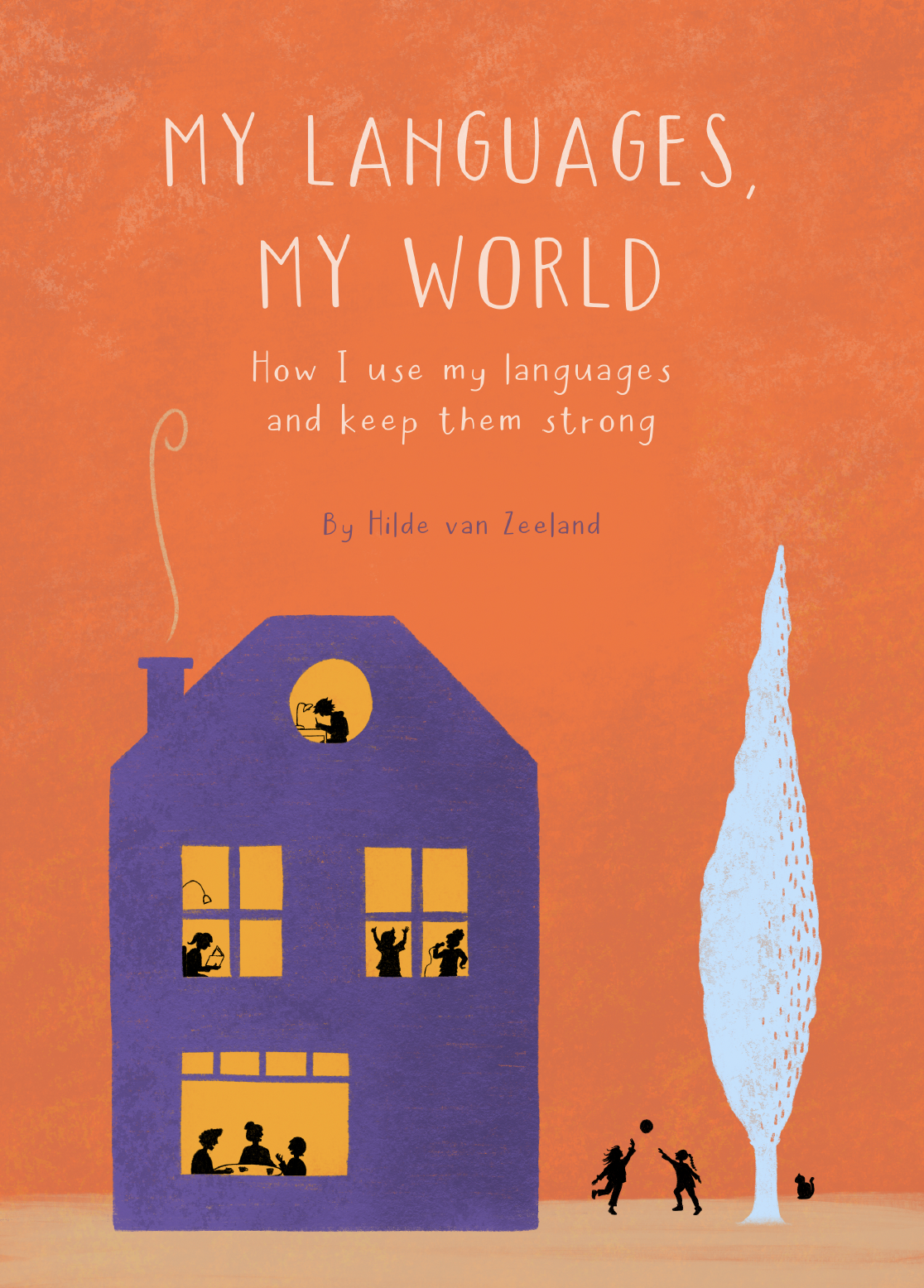
My Languages, My World
A workbook for bilingual and multilingual children to explore their own language landscape. They reflect on when, where, and with whom they speak each language, and set their own language wish for keeping their languages close.
References
[1] Montrul, S. (2016). The Acquisition of Heritage Languages. Cambridge: Cambridge University Press.
[2] Merino, B. (1983). Language loss in bilingual Chicano children. Journal of Applied Developmental Psychology, 4(3), 277–294. https://doi.org/10.1016/0193-3973(83)90023-0
[3] Gathercole, V.C.M., & Thomas, E.M. (2009). Bilingual first-language development: Dominant language takeover, threatened minority language take-up. Bilingualism: Language and Cognition, 12(2), 312–337. https://doi.org/10.1017/S1366728909004015
[4] Silva-Corvalán, C. (2014). Bilingual Language Acquisition: Spanish and English in the First Six Years. Cambridge: Cambridge University Press.
[5] Montanari, S. (2009). Multi-word combinations and the emergence of differentiated ordering patterns in early trilingual development. Bilingualism: Language and Cognition, 12(4), 503–519. https://doi.org/10.1017/S1366728909990265
[6] Wilson, S. (2020). Family language policy through the eyes of bilingual children: the case of French heritage speakers in the UK. Journal of Multilingual and Multicultural Development, 41(2), 121–139. https://doi.org/10.1080/01434632.2019.1595633
[7] Slavkov, N. (2017). Family language policy and school language choice: Pathways to bilingualism and multilingualism in a Canadian context. International Journal of Multilingualism, 14(4), 378–400.