
The sibling effect: how brothers and sisters shape a family's languages
Many materials on how to raise bilingual children treat the child as the recipient and the parents as the providers. It’s the parents’ choices that matter: OPOL or not, which language at the dinner table, or how to handle language mixing. But the moment a second child arrives and the first starts going to school, a different force enters the system. Siblings turn out to shape each other’s language use in ways no OPOL or other strategy fully reaches.
The school effect, transmitted through siblings
The clearest finding in the sibling literature is that once one child enters school, the school’s language tends to follow them home. A language shift in the family often begins when sibling interaction starts to be structured around the school language.[1] For instance, Kheirkhah and Cekaite found that the school language dominated sibling conversations, and that this contributed to a family-level shift toward the majority language.[2] Barron-Hauwaert showed how older siblings, once in school, tend to tip the language balance toward the school’s language for the whole sibling group.[3]
When older kids develop a preference for the school language, the home language might start to suffer. Yamamoto’s work on Japanese-English bilingual families showed this directly, identifying siblings as one of the most influential factors against minority-language use at home.[4]
So while you might find it’s easy to set language norms during your child’s pre-school years (when your own input still dominates), this can change when school enters the picture. Not only does school add a new input source; it also changes the language the children use with each other (find another post here about the school language taking over).
The flip side: siblings for linguistic creativity
It would be easy to read all of this as a story about loss, but the research also shows that sibling interaction is rich in language play, like language mixing, humor, invented words, inter-language puns, and creative translations between the family’s languages. Siblings often create their own bilingual jokes and improvised constructions,[3] and their interaction has been described as a space where languages coexist rather than alternate.[5] This means siblings can motivate each other to keep using the home language, even if this is combined with the school language.
Research has also shown that, as sibling interaction is key to learning, it can play an active role in revitalizing languages: when the home language isn’t as active as it used to be, siblings’ use of that language can help to reinforce it again.[6] It’s best when siblings have something to do with the language together: think of shared media, family visits, meetups with friends that speak the language, or a shared goal. Studies have found that older siblings often help younger ones to read in the home language[6], which could motivate them to use the language more often together.
On motivating siblings to use the home language
What we can take from all this is that the start of school will likely change the language(s) spoken at home, especially between siblings. At the same time, older siblings can help to keep the home language active when they’re motivated to. This means it’s good to think ahead:
- If you’re welcoming a second child into the family, this is a good time to start thinking ahead about sibling language. It might be too early to think of activities, but you could already help your older child to keep the home language strong. Use the My Languages, My World workbook to help them appreciate their languages and see they’re worth keeping.
- It’s also good to prepare for the school-entry transition of your first child. Knowing the shift is likely coming gives you room to plan around it: a Saturday school in the home language, regular video calls with family to speak the language, etc.
Finally, it helps to be realistic about the limits of your strategy. The OPOL discussion in another post made the point that our choices as parents aren’t the only factor in multilingual outcomes, and the sibling research reinforces this. As Barron-Hauwaert summarizes, siblings often make their preferred sibling language choice independently of their parents’ language strategy.[3] We can try to shape our kids’ interaction, but not run it. Accepting that, and planning around it, tends to be more useful than trying to micromanage every sentence.
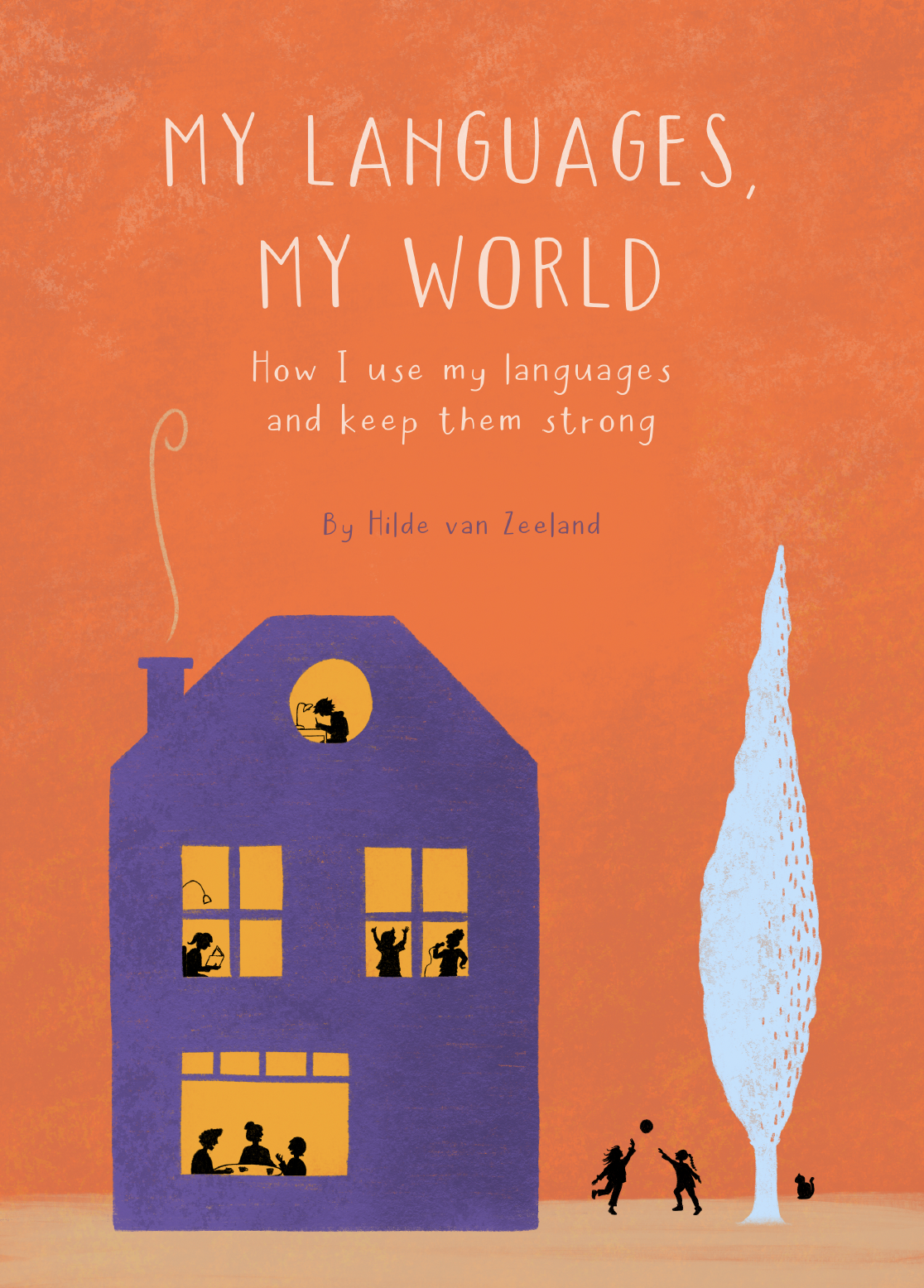
My Languages, My World
A workbook for bilingual and multilingual children to explore their own language landscape. They reflect on when, where, and with whom they speak each language, and set their own language wish for keeping their languages close.
References
[1] Shin, S. (2005). Developing in Two Languages: Korean Children in America. Clevedon: Multilingual Matters.
[2] Kheirkhah, M., & Cekaite, A. (2015). Language maintenance in a multilingual family: Informal heritage language lessons in parent-child interactions. Multilingua, 34(3), 319-346.
[3] Barron-Hauwaert, S. (2011). Bilingual Siblings: Language Use in Families. Bristol: Multilingual Matters.
[4] Yamamoto, M. (2001). Language Use in Interlingual Families: A Japanese-English Sociolinguistic Study. Clevedon: Multilingual Matters.
[5] De Leon, L. (2018). Playing at being bilingual: Bilingual performances, stance, and language scaling in Mayan Tzotzil. Journal of Pragmatics, 144, 92-108. https://doi.org/10.1016/j.pragma.2018.02.006
[6] Macleroy, V. (2022). Siblings’ Multilingual Discourse. In A. Stavans & U. Jessner (Eds.), The Cambridge Handbook of Childhood Multilingualism (pp. 325–352). Cambridge: Cambridge University Press.