
"Should I even try?" Raising bilingual kids when you're not a native speaker
Few questions in multilingual parenting come up more often than this one: I’m not a native speaker of this language. Should I still try to raise my child in it? The replies tend to divide into two camps. One says: any input is good input, go ahead. The other says: leave it to the natives, you’ll only pass on your mistakes. The research shows that the honest answer depends on a few questions, which we’re looking at here.
Will your child learn this language otherwise?
This is the single biggest factor, and most of the debate ignores it. If your child is being raised in a country where school, your partner, and the surrounding community all speak Language X, and you are the only available source of Language Y, then the choice in front of you is your non-native input versus no input at all. Without you, your child wouldn’t get a chance to learn the language.
The research is clear on this. Children need substantial input to keep developing, with the threshold rising as they get older [1]. Children’s chances of learning a language at home is directly affected by how much this language is used within the family [2]. So clearly, imperfect input from one parent is definitely better than no input at all.
This reasoning assumes the language in question is the minority language in your child’s environment: the one they wouldn’t otherwise learn. If that’s not your situation, the logic inverts. If your child will already learn the language from school and peers, even if this only starts at school age, they don’t need you for it. In that case, you might want to make your native language the home language, as more majority/school language at home means less chances of kids learning the minority language [2].
The caveat: input quality matters
This is where it would be dishonest to skip past the harder finding. In an earlier post, we saw that not just quantity, but especially quality of input matters. It turns out that this also applies to non-native speech. A few studies:
- Place and Hoff found that Spanish-English two-year-olds’ English vocabulary skills were influenced by the percentage of the child’s English exposure that was provided by native speakers, with more native input leading to higher English skills [3].
- Another study confirmed this, with 2,5-year-old Spanish-English bilingual children showing better English skills if they were exposed more to native (vs. non-native) English speech.[4]
More recent studies give a more nuanced view, showing that it isn’t so much native vs. non-native, but the proficiency of the non-native speakers that seems to matter.
- Unsworth and colleagues [5] studied children who learned Dutch alongside another language at home in The Netherlands, and found that whereas the presence of a native parent (or proportion of native input) didn’t predict language skill, the proficiency of any non-native caregiver did, with higher non-native proficiency generally meaning better language development of the child.
- Another recent study found that speech directed to Spanish-English bilingual children led to more learning if this came from more proficient non-native mothers than from lower-proficiency ones.[6]
So the richer and more proficient the speaker’s input, the better for learning. If your version of the language tops out at day-to-day phrase level, this might be sufficient depending on the level you’d like your child to reach. But if you would like to go beyond this, it’s good to bring in scaffolding from elsewhere. Think of books, podcasts, video calls, play dates; anything that adds the more advanced input that your own speech doesn’t.
So, should you raise your kid in a language if you’re not a native speaker?
Based on the above research, we see that if you’re a non-native but speak a language well, you can most certainly raise your child in that language. The standard worry (am I qualified as a non-native?) isn’t the right frame. Instead, it’s better to ask yourself: given what exposure my child will or won’t otherwise get, what can I offer? The general principle I would advise:
- Use your non-native language at home when it’s the language your child won’t otherwise hear (and you feel capable and comfortable using it); as we know non-native proficiency and language quality affect learning, you can bring richer input from elsewhere if you feel this would advance your child’s level.
- Use your native language at home when the other language is already in the air around them (through school/society); they don’t need you to learn the school language, but they likely do to learn the home language.
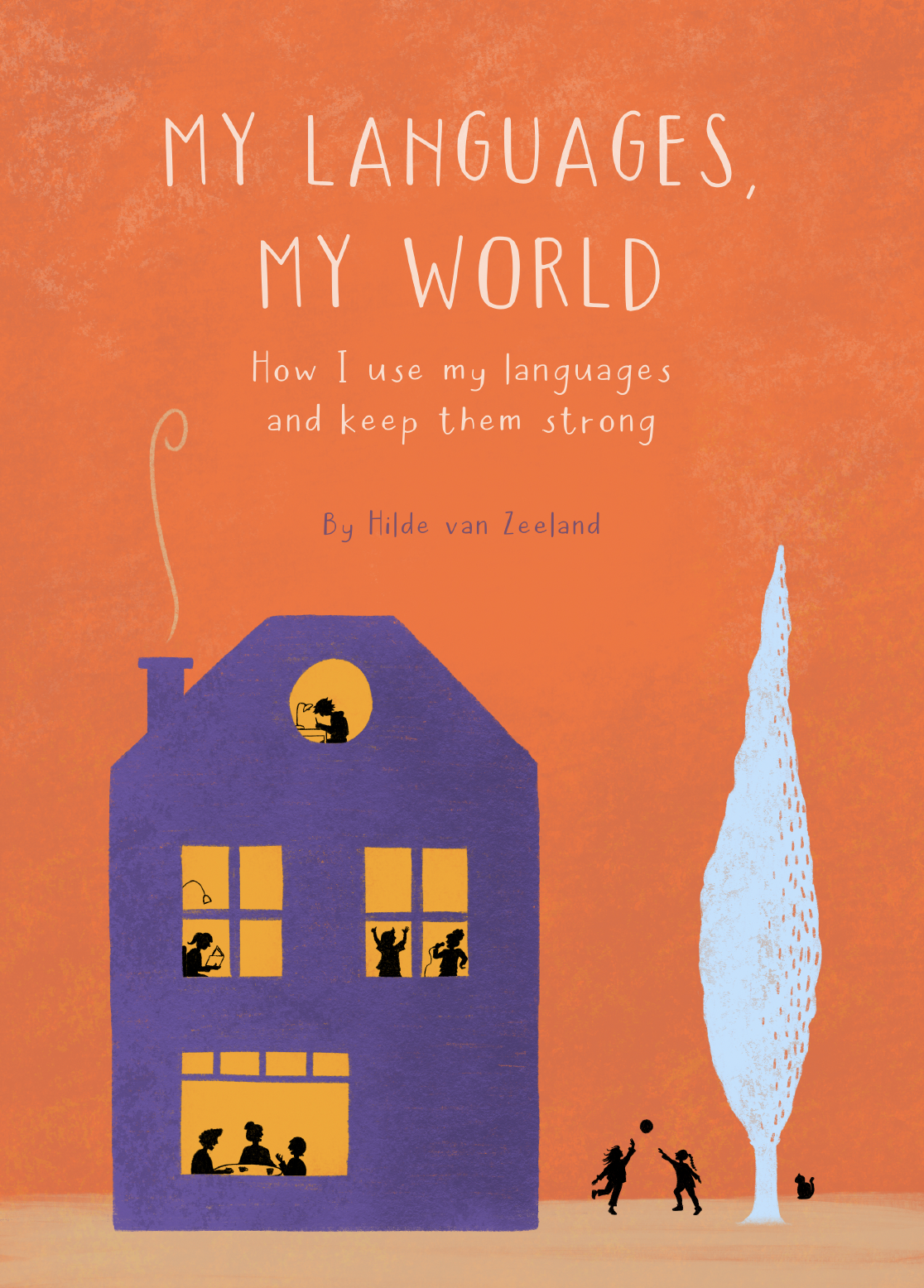
My Languages, My World
A workbook for bilingual and multilingual children to explore their own language landscape. They reflect on when, where, and with whom they speak each language, and set their own language wish for keeping their languages close.
References
[1] Silva-Corvalán, C. (2014). Bilingual Language Acquisition: Spanish and English in the First Six Years. Cambridge: Cambridge University Press.
[2] De Houwer, A. Language input environments and language development in bilingual acquisition. Applied Linguistics Review, 2, 221-240. https://doi.org/10.1515/9783110239331.221
[3] Place, S., & Hoff, E. (2011). Properties of dual language exposure that influence 2-year-olds’ bilingual proficiency. Child development, 82(6), 1834-1849. https://doi.org/10.1111/j.1467-8624.2011.01660.x
[4] Place, S., & Hoff E. (2016). Effects and noneffects of input in bilingual environments on dual language skills in 2½-year-olds. Bilingualism: Language and Cognition, 19(5), 1023-1041. https://doi.org/10.1017/S1366728915000322
[5] Unsworth, S., Brouwer, S., de Bree, E., & Verhagen, J. (2019). Predicting bilingual preschoolers’ patterns of language development: Degree of non-native input matters. Applied Psycholinguistics, 40, 1189-1219. https://doi.org/10.1017/S0142716419000225
[6] Hoff, E., Core, C., & and Shanks, K. F. (2020). The quality of child-directed speech depends on the speaker’s language proficiency. Journal of Child Language, 47, 132-145. https://doi.org/10.1017/S030500091900028X